
Branding Strategy | Guide, Frameworks & Examples
Branding strategy is the cornerstone of every successful brand. A strong brand isn’t built around a logo, tagline, or color palette. A strong brand is built around a strategic core that defines how it should be seen, who it’s for, and why people should choose it over others.
A branding strategy is this strategic core. It aligns audience insights, brand identity, positioning, and messaging into a consistent system that guides every customer interaction. Without a branding strategy, brands usually feel inconsistent, generic, or interchangeable.
This guide breaks down what branding strategy is, its core elements, and how it differs from other branding concepts. You’ll also learn how to build a branding strategy step by step, with actionable frameworks and real-world examples to help steer you in the right direction.
AI tools like Quillbot’s AI Chat can assist you as you develop your branding strategy. Use it to brainstorm ideas, analyze target audience demographics, create variations of messages, and more.
Key takeaways
- A branding strategy is the foundation of how your business is perceived. It defines what you stand for, who you serve, and how you communicate your value across every touchpoint, from messaging and design to customer experience.
- Strong branding starts with clarity. Understanding your target audience, defining your positioning, and identifying your unique value proposition allow you to stand out in a crowded market instead of competing on price alone.
- A complete branding strategy connects purpose, personality, messaging, and visual identity into a consistent system. When these elements align, they create recognition, trust, and a more emotionally engaged audience.
- Effective branding isn’t just about visibility; it drives long-term growth by improving differentiation, strengthening customer loyalty, and enabling premium pricing through consistent brand value and perception.
Table of contents
- What is a branding strategy?
- Branding strategy vs other similar terms
- Why branding strategy matters
- The core elements of a branding strategy
- How to create a branding strategy: a step-by-step framework
- Branding strategy examples
- Common branding strategy mistakes
- Branding strategy trends
- Frequently asked questions about branding strategy
- Other interesting articles
What is a branding strategy?
A branding strategy is a long-term plan to achieve the long-term goals related to how customers identify, perceive, and prefer your brand. It determines how a business or organization will present itself to the market and be perceived by the public.
A branding strategy establishes core branding elements, such as positioning, visual identity, personality, messaging, etc. In other words, a branding strategy is the roadmap that guides the decisions an organization makes about everything from logos to typography to product packaging to customer experience.
Branding strategy vs other similar terms
Branding strategy intersects with several other related concepts, specifically branding, brand identity, branding design, and marketing strategy.
Branding strategy vs other similar terms
| Concept | Definition | Purpose |
|---|---|---|
| Branding strategy | A long-term plan that defines how a brand is positioned, perceived, and differentiated in the market | To shape consistent brand perception, guide all brand decisions, and build long-term brand equity |
| Branding | The overall process of creating and managing how a brand is perceived across all touchpoints; the execution of a branding strategy | To influence customer perception and build recognition, trust, and emotional connection |
| Brand identity | The set of tangible and intangible elements that represent a brand (visual, verbal, and sensory assets) | To create recognition and consistency in how the brand looks, sounds, and feels |
| Branding design | The visual execution of a brand identity, including logo, typography, color systems, and visual assets | To visually communicate the brand and deliver consistent, recognizable aesthetics across platforms |
| Marketing strategy | A plan that focuses on how a business attracts, converts, and retains customers through channels and campaigns | To drive demand, generate leads, and support business growth through promotion and distribution |
To use a metaphor, imagine your brand as a house:
- Branding strategy is the architectural blueprint that defines structure, purpose, and how people should experience the house.
- Branding is the building process that brings the blueprint to life.
- Brand identity is the interior and exterior system that defines the house’s “look and feel” (e.g., materials, paint colors, decor style, layout choices, and gardening).
- Branding design is the selection, preparation, and installation of these design elements.
- Marketing strategy is the plan that decides how to price the house, where and how to advertise it, and how to attract and convert potential buyers.
- Organizations structure these duties differently. In some companies, one team handles branding, marketing, and design together. In others, separate teams manage brand strategy, brand management, brand design, and marketing strategy independently.
- Agencies and consultants often use jargon. Branding terminology can vary across industries and organizations, and this trickles into online content. This is especially relevant now, as many people use AI tools like ChatGPT and Gemini, which answer questions by pulling information from well-ranked websites.
- Online branding discussions tend to focus heavily on visuals. Logos, color palettes, and packaging are easier to showcase and discuss than positioning, perception, or customer psychology. As a result, much of the branding content online focuses on visual identity while overlooking strategic foundations.
Why branding strategy matters
A branding strategy matters on every level. It’s instrumental in helping your brand stand out from the competition, building trust among your audience, and driving long-term growth. A few key reasons why a branding strategy is absolutely essential are:
- It differentiates your brand. In saturated markets, a branding strategy helps you communicate your positioning so you’re not just another “face in the crowd.” This demonstrates to your audience what unique value your brand provides and convinces them to choose you over competitors.
- It builds recognition and trust. A clear branding strategy promotes consistency in your visual identity and brand personality across all channels, leading to better recognition among customers. This recognition combined with further consistency over time leads to consumer trust in your brand.
- It fosters emotional connection and loyalty. Nowadays, consumers generally choose brands whose values align with their own. A strong branding strategy transmits your mission and values, which builds an emotional connection and sense of loyalty with your target audience.
- It strengthens pricing power. Brand equity is the perceived value of a brand exclusive of its products or services. Think of prestigious brands like Apple, Google, or Gucci; all of these brands have high equity. It’s impossible to build brand equity without a branding strategy. But once you do, you’ll be able to charge higher prices and better shield yourself against market fluctuations.
- It streamlines decision-making. A well-developed branding strategy explains what your brand is and what it isn’t. It also tells your team what they should do and what they shouldn’t do when representing your brand. This leads to faster and more confident decision-making among all teams.
What happens without a branding strategy
Operating without a branding strategy is like a person with myopia leaving the house without glasses; you might be able to see what’s right in front of you but can’t tell what’s coming. Not having a branding strategy leaves you shortsighted and can also result in:
- Loss of audience trust. Without a branding strategy, you end up with mixed messaging and inconsistent customer experience. Different channels (e.g., your website, packaging, and customer service) come to feel like different companies. This fractured identity causes the audience to not trust your brand, which leads to them choosing more solid competitors over you.
- Poor customer retention. Likewise, existing customers will also pick up on a lack of branding strategy quicker than you think. Even if they’ve already made a purchase and are happy with your product or service, the anxiety caused by inconsistent branding can cause them to shift to a competitor.
- Wasted budget. Marketing and advertising without a branding strategy essentially throws away money. For example, your ads, website, and sales materials might communicate different promises or create inconsistent experiences, causing leads to lose trust or drop out of the funnel.
- Getting boxed in. Not having a branding strategy limits the space you can occupy in your market. To start, if you don’t have a unique value proposition, the only thing that differentiates you from competitors is price, leaving you to operate within limited profit margins. Further, if at some point, you need to pivot your positioning or expand your offerings, this will be more difficult to do without strong branding foundations—and strong audience trust—in place.
- Internal misalignment. A branding strategy guides corporate culture, and without one, employees may lack direction, motivation, and the feeling of a shared mission. This can lead to lower overall morale, poor customer service, and listless marketing campaigns. Moreover, as a company grows or goes remote, it gets harder for different departments to correctly communicate the brand’s mission and offerings.
The core elements of a branding strategy
Before you can create your own branding strategy, you should understand the core elements that make one up. When reading about how to create your own branding strategy, you may want to refer back to this section to help you develop each element.
Target audience
Your target audience is the specific group of people with shared needs, behaviors, motivations, and expectations that your brand is designed for. A branding strategy is only effective when it’s built around a target audience, which shapes everything from positioning to messaging to visual identity to customer service.
There are various audience segmentation frameworks that help you understand your target audience, such as demographics, psychographics, motivations, and pain points.
Demographics and psychographics
Demographics are quantifiable, statistical, and external characteristics of a group. Psychographics refer to psychological, emotional, and behavioral traits. The table below shows examples of some demographics and psychographics.
Demographics and psychographics
| Demographics | Psychographics | ||
|---|---|---|---|
| Data point | Example | Data point | Example |
| Age | 25–40 years old | Values | Sustainability and ethical consumption |
| Gender | All | Interests | Fitness, fashion, and environmental issues |
| Location | Urban and suburban areas | Hobbies | Hiking, cycling, and yoga |
| Occupation | Young professionals and creatives | Lifestyle | Active, health-conscious, and eco-aware |
| Family status | Single professionals or young families | Aspirations | Reducing environmental impact without sacrificing style |
| Race or ethnicity | All | Personality | Conscientious, modern, and purpose-driven |
| Income | Middle- to upper-middle income | Attitudes | Willing to pay more for sustainable products |
| Education level | University | Opinions | Brands with transparent sourcing and production practices are best |
For branding strategy, psychographics are often more valuable, as they explain how customers see themselves and what emotional associations influence their buying behavior. For example, two customers with similar demographics might respond to different branding depending on whether they prioritize status, sustainability, creativity, or affordability.
That said, demographics provide useful context, too. While psychographics tell you how to communicate with your customers, demographics often tell you how to reach them. For example, if you’re targeting Gen Zers, it would be better to prioritize TikTok over Facebook, given where that generation spends its time online.
Motivations and pain points
Motivations are the values, goals, and desires that drive the audience’s actions, and pain points are the problems, obstacles, unmet needs, and frustrations that influence decision-making. Strong branding strategies are built around understanding what customers want, what problems they are trying to solve, and what’s standing in their way.
Some key types of motivations are outlined in the table below. Understanding which of these are relevant to your target audience helps you better communicate your brand to them.
Target audience motivation examples
| Type | Example |
|---|---|
| Emotional or aspirational | To feel successful, confident or respected |
| To find a sense of freedom, adventure, or creativity | |
| To reduce stress, anxiety, or frustration | |
| To find products or services that align with the ideal version of themselves | |
| Practical | To save time or money |
| To improve efficiency or convenience | |
| To solve a specific problem quickly and reliably | |
| To find products that are durable, functional, and user-friendly | |
| Social | To fit in with a group or community |
| To gain status, recognition, or approval | |
| To express individuality or cultural identity | |
| To have products or experiences that are socially shareable | |
| Value-driven | To support ethical or sustainable businesses |
| To prioritize transparency and authenticity | |
| To choose quality and long-term value over low prices | |
| To choose brands that align with their political, environmental, and/or social beliefs |
Recognizing pain points allows you to position your brand as the perfect solution. Pain points typically fall into four categories:
- Financial: High prices, not enough value for money, budget constraints, hidden fees, expensive subscriptions, poor return on investment, products that require costly maintenance or upgrades, etc.
- Process: Overly complex systems, confusing user interfaces, difficult onboarding, slow checkout processes, complicated workflows, unclear instructions, inefficient customer journeys, etc.
- Productivity: Time-consuming tasks, repetitive manual work, poor organization tools, workflow bottlenecks, difficulty collaborating with teams, distractions, products that reduce efficiency instead of improving it, etc.
- Support: Slow customer service, difficulty reaching support teams, lack of personalized assistance, unresolved technical issues, poor communication, limited self-service resources, or inconsistent customer experiences, etc.
The more clearly you understand these motivations and frustrations, the more effectively you can shape your branding strategy to be relevant and valuable to your target audience.
Her motivations include feeling healthier, more in control of her routine, and eating more intentionally. Her pain points include lack of time, complex recipes, and overwhelming meal planning.
With these insights, Northline shifts its branding from “fast and convenient” to “reducing mental load and helping people feel balanced.” Messaging becomes more emotionally driven, focusing on simplicity and relief rather than speed alone, and the visual identity reflects a calmer, more supportive tone.
Identity signaling
Identity signaling is a behavioral science concept that refers to when people use behaviors, opinions, products, and brands to communicate something about themselves to others. For example, customers may choose certain brands because they want to appear environmentally conscious, innovative, luxury-oriented, minimalist, rebellious, or health-focused.
People signal primarily to fulfill three psychological needs:
- Belonging: Some people signal to show they belong to a certain group, community, or subculture, such as a teenager interested in punk rock cutting their hair into a mohawk and wearing ripped clothes.
- Self-expression: Others may signal to demonstrate aspects of their personality, worldview, political beliefs, or morals, like a nature lover who only wears clothes from sustainable brands.
- Self-enhancement: People also signal to indicate self-worth and social status, like someone who carries a luxury bag to show they have the financial capacity to do so.
This is why branding strategy must extend beyond product features. Successful brands connect with customers on a symbolic and emotional level, not just a functional one. When a brand’s story and mission match a customer’s personal identity, it builds a long-term, deeply loyal, and trusting relationship.
- Loud signals include high-visibility logos, like monogrammed designer bags. These are used by consumers who want to clearly, quickly communicate status or wealth to a wide audience.
- Quiet signals use subtle, discreet branding, like high-quality materials and perfect craftsmanship. Consumers who use these signals want to communicate that they’re in an exclusive group, are “in the know,” and/or have nothing to prove.
Brand purpose, mission, and values
Brand purpose, mission, and values are closely related but distinct elements of a branding strategy, which, when clearly defined, help align internal teams, guide messaging, and strengthen customer trust over time:
- Purpose defines why the brand exists beyond making money
- Mission defines what the brand does, who it serves, and how it delivers value
- Values define the principles and beliefs that guide how a brand behaves
A strong purpose is a foundational idea that influences decision-making across the organization. A clear mission supports consistency across teams and provides direction for product development, marketing, and customer experience. And values—when actionable and consistently reflected—allow you to connect on an emotional level with your customers.
When these three elements are aligned in branding strategy, they create a strategically and behaviorally coherent brand across every customer interaction. This helps you communicate value, build trust, and bolster your connection with your audience.
Brand positioning
Brand positioning defines how a brand is perceived in the minds of its target audience in relation to competitors. It determines the specific space a brand takes up in the market and clarifies why a customer should choose you.
Successful positioning works by connecting three key elements:
- The target audience: who your brand serves
- The competitive landscape: who you’re up against and what they offer
- Value proposition: your brand’s unique value or perspective and the specific benefits you offer
Strong brand positioning identifies a gap in the market or a differentiated angle and deliberately occupies that space. It shapes customer preferences, drives sales and brand loyalty, aligns your marketing with your target audience, and keeps your brand present in a crowded market.
Brand personality
Brand personality is the collection of human traits, characteristics, and values that affect how a brand behaves and communicates. Brand personality also impacts how a brand is perceived by its audience. It turns a company into a relatable entity, which helps customers more easily trust and connect with the brand.
Brand personality is typically expressed through traits such as:
- Brand voice is the consistent way a brand speaks, including vocabulary, sentence structure, and formality. It defines how the brand “sounds” across all written and spoken communication.
- Tone is the emotional variation of the brand voice depending on context. While voice stays consistent, tone adapts (e.g., supportive in customer service and energetic in marketing campaigns).
- Emotional style refers to the dominant feelings a brand aims to evoke in its audience, such as trust, excitement, calm, empowerment, or aspiration.
- Brand behavior is how the brand acts across customer touchpoints, including responsiveness, transparency, and service quality. It directly informs overall customer service.
- Visual identity is the visual expression of the brand (e.g., logo, color palette, typography, imagery, and design system). It reinforces personality through aesthetics.
These traits should remain consistent across channels so that the brand feels coherent, regardless of where or how a customer interacts with it.
Defining a brand personality can be difficult, but there are some frameworks that branding and marketing specialists use to make the process a bit easier.
Brand personality dimensions
One framework, created by behavioral scientist Jennifer Aaker, divides brand personalities into five core dimensions, as outlined below. These dimensions provide a structured way to define how a brand is perceived emotionally and behaviorally, helping ensure consistency across messaging, visuals, and customer experience.
Brand personality dimensions
| Dimension | Traits | Focus | Examples |
|---|---|---|---|
| Sincerity | Honest, warm, down-to-earth, family-oriented, genuine | Authenticity, trust, transparency, and emotional warmth | Dove, Patagonia, IKEA |
| Excitement | Energetic, bold, youthful, adventurous, imaginative | Emotional stimulation, novelty, strong engagement, cutting-edge trends | Nike, Red Bull, GoPro |
| Competence | Reliable, intelligent, efficient, professional, successful | Expertise, leadership, efficiency, and high performance | Toyota, Google, Apple |
| Sophistication | Elegant, premium, refined, aspirational, luxurious | Status, exclusivity, and high-quality experience | Rolex, Chanel, Mercedes-Benz |
| Ruggedness | Tough, durable, outdoorsy, strong, resilient | Durability, endurance, and connection to nature or physical challenge | The North Face, Timberland, Jeep |
A strong brand should occupy more than one dimension; for example, Apple conveys both competence and sophistication.
Brand personality archetypes
Another framework focuses on brand personality archetypes, based on the common personality archetypes outlined by psychologist Carl Jung. Archetypes influence how people interpret behavior, storytelling, and identity on a largely subconscious level. In branding, they create emotional meaning and help audiences quickly understand what a brand represents.
This table provides a big-picture view of the brand personality archetypes. If you’d like to explore them further, ask Quillbot’s AI Chat to explain them in greater depth.
Brand personality archetypes
| Archetype | Core goal | Description | Example brands |
|---|---|---|---|
| Hero | Prove strength through mastery and achievement | Focuses on overcoming challenges, building discipline, and inspiring others | Nike, Adidas |
| Magician | Transform reality and create meaningful change | Centers on innovation, transformation, and turning vision into reality through creativity or technology | Disney, Tesla |
| Outlaw | Challenge the status quo and disrupt norms | Rejects convention, embraces rebellion, and positions itself against established systems | Harley-Davidson, Diesel |
| Jester | Bring joy and live in the moment | Uses humor, playfulness, and entertainment to engage audiences and reduce seriousness | M&M’s, Old Spice |
| Lover | Create intimacy and emotional connection | Focuses on beauty, passion, sensory experience, and relationships | Chanel, Victoria’s Secret |
| Everyman | Belong and be relatable | Emphasizes accessibility, authenticity, and being “just like everyone else” | IKEA, Levi’s |
| Creator | Build something meaningful and original | Driven by imagination, self-expression, and innovation | Adobe, LEGO |
| Ruler | Create order and maintain control | Focuses on authority, leadership, stability, and premium positioning | Rolex, Mercedes-Benz |
| Caregiver | Protect and help others | Centers on support, compassion, safety, and trust | Johnson & Johnson, Dove |
| Innocent | Promote simplicity and optimism | Focuses on purity, happiness, and trust in a better world | Coca-Cola, Dove |
| Sage | Seek truth and share knowledge | Driven by wisdom, research, and intellectual authority | Google, BBC |
| Explorer | Discover freedom and new experiences | Focuses on adventure, independence, and pushing boundaries | The North Face, Jeep |
An archetype isn’t a complete brand personality; rather, it’s a starting point. An archetype helps guide your decision-making with respect to the components of brand personality (e.g., brand voice and visual identity).
Brand messaging
Brand messaging is how your brand uses language to communicate its mission, values, and value proposition. Brand messaging is directly shaped by your target audience, brand positioning, and brand personality.
The core components of brand messaging are:
- Brand voice and tone: The communication style of your brand. Voice is consistent, but tone changes with context.
- Content pillars: The main themes or topics your brand speaks about. Pillars keep your brand messaging focused on what your audience is interested in.
- Taglines and slogans: Short, memorable phrases that capture what your brand is all about. They communicate your brand essence quickly and hook the audience.
- Messaging guidelines: A structured set of rules that include preferred language, key messages, positioning statements, do’s and don’ts, and how to adapt messaging for different audiences and channels while maintaining consistency.
- Proof points: Concrete evidence (e.g., data, case studies, and testimonials) that supports brand claims, validates the brand’s promises, and builds credibility.
Branding strategy needs to address brand messaging so that you have a consistent, actionable communication plan that reinforces your brand positioning. This prevents fragmented or contradictory messages and makes sure all brand expressions support the same strategic intent.
Visual identity
Visual identity is the aesthetic expression of your brand. It’s the most immediately visible expression of a branding strategy, and it should always be driven by strategic decisions and not treated as an isolated design exercise.
Visual identity includes:
- Logo: The primary visual symbol of the brand, including variations for different contexts (e.g., full logo, icon, monochrome versions). It acts as the core identifier of the brand.
- Color palette: A set of primary and secondary colors that communicate emotion, tone, and positioning. Color helps reinforce recognition and sets the overall mood of the brand.
- Typography: The chosen typefaces used across all brand communications. Typography influences readability and helps express personality, whether modern, traditional, playful, or premium.
- Imagery style: The consistent approach to photography, illustration, or visual content. This includes composition, lighting, subject matter, and editing style, all of which reinforce brand personality.
- Graphics and icons: Supporting visual elements such as icons, patterns, illustrations, and graphic motifs that add cohesion and reinforce brand recognition across materials.
- Layouts: The structural system used to arrange visual elements across platforms, including spacing, grid systems, hierarchy, and composition rules that ensure consistency and clarity.
A strong visual identity keeps your brand consistent, reinforces brand meaning, and helps create instant recognition in a crowded market. While it does not define the branding strategy itself, it translates strategy into tangible, visual form.
How to create a branding strategy: a step-by-step framework
A branding strategy is not created in one sitting. It develops through research, analysis, positioning, execution, and refinement. While every brand approaches the process differently, most successful branding strategies follow these same core steps.
1. Conduct market research
Branding strategy should begin with research, not assumptions. Market research offers insight into your industry, customer expectations, market trends, and the broader competitive landscape before making strategic decisions. This replaces guesswork with evidence and helps you confidently launch your branding strategy.
The goal is to identify patterns in customer behavior, motivations, frustrations, and unmet needs. These insights help ensure your branding strategy is grounded in reality rather than internal preferences.
There are three focus areas within market research, outlined in the table below. Ideally, your market research should cover all three.
Three focus areas of market research
| Research area | Focus | Example insights |
|---|---|---|
| Customer | Understanding consumer preferences, pain points, motivations, expectations, and buying behaviors | What customers value most, why they choose competitors, common frustrations, emotional motivations, preferred communication channels |
| Competitor | Analyzing the market landscape, competitor positioning, strengths, weaknesses, pricing strategies, and messaging | Market gaps, oversaturated positioning trends, pricing benchmarks, competitor advantages, differentiation opportunities |
| Product | Evaluating the feasibility, usability, pricing, and messaging of a product or service before launch | Whether customers understand the value proposition, acceptable price ranges, feature priorities, messaging effectiveness, potential adoption barriers |
So, practically speaking, how can you conduct this research? Some methods, frameworks, and other marketing fundamentals that can help are:
- Customer interviews: Speak directly with customers to understand motivations, frustrations, expectations, and decision-making processes in depth.
- Surveys and questionnaires: Gather structured feedback from larger groups to identify patterns, preferences, and trends.
- Focus groups: Facilitate guided group discussions to explore audience views, reactions, and emotional responses to products, messaging, or branding concepts.
- Social listening: Monitor conversations on social media, forums, and online communities to identify recurring opinions, concerns, and cultural trends.
- Review mining: Analyze customer reviews of your brand and competitors to uncover common praise, complaints, and unmet needs.
- Website and SEO analytics: Use analytics tools to understand audience behavior, traffic sources, user journeys, and search intent. See who’s already visiting your platforms and learn how your audience is searching for what they need.
- Competitor audits: Evaluate competitors’ positioning, messaging, pricing, design, and customer experience to identify market patterns and differentiation opportunities.
- SWOT analysis: Assess your brand’s strengths, weaknesses, opportunities, and threats to better understand strategic positioning.
- Market segmentation: Divide audiences into groups based on demographics, psychographics, behaviors, or needs to refine targeting and messaging.
- Customer journey mapping: Visualize the steps customers take before, during, and after purchase to identify friction points and opportunities for improvement.
- A/B testing: Compare variations of messaging, visuals, pricing, or user experiences to determine which performs more effectively.
- Trend and industry reports: Study market research reports and industry publications to understand broader consumer and competitive trends.
Research can also be qualitative (non-numerical), which looks at why your audience feels or acts the way they do, and quantitative (numerical), which helps you see what trends look like across large groups of people.
2. Identify your target audience
Your branding strategy needs to focus on a clearly defined audience in order to be effective; no brand can simply target everyone. In the last step, you conducted market research, including research into your target audience. Now, it’s time to identify that target audience so you have a clear view going forward of who your brand is for.
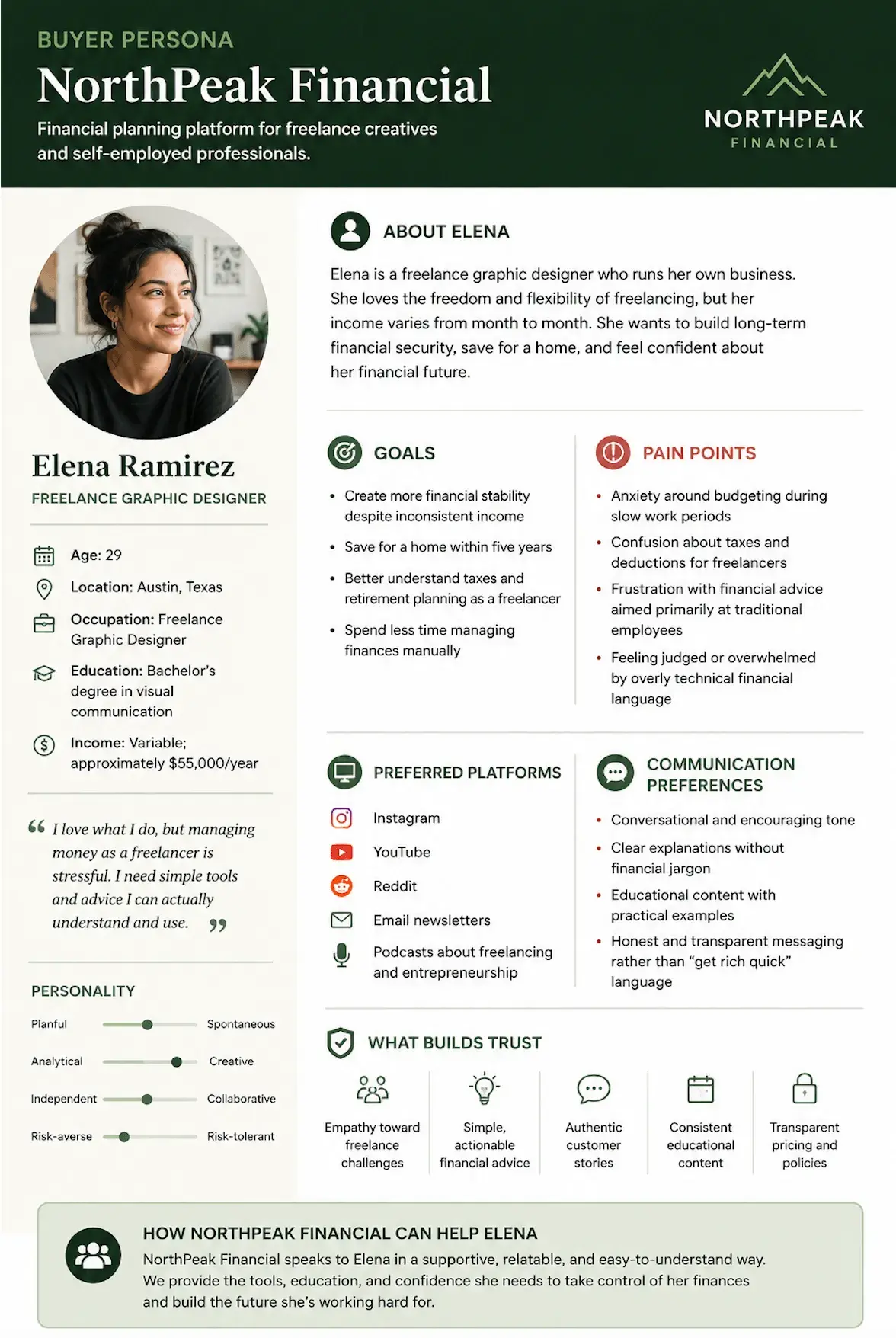
Identify your audience’s demographics, psychographics, customer pain points, emotional motivations, purchasing behaviors, and identity-signaling tendencies. One of the most common ways to record this information is in a buyer persona. A persona is a fictional profile that represents your target customer(s).
They create the following buyer persona:
3. Define your brand positioning
You’ve identified your target audience, and you know what your competitors are up to. Now, it’s time to reflect on what your brand can offer that’s unique and channel that into your brand positioning.
You can find your brand positioning at the intersection of three crucial elements:
- What your audience wants (their needs, desires, and pain points)
- What your competitors are offering (the market landscape)
- What your brand is capable of (your unique selling proposition and core competencies)
Write a positioning statement to have a structured way to think of your brand. Two common formulas are:
- For [target audience], [brand] is the [category] that provides [unique value], because [reason or “proof”].
- For [target audience], [brand] is the [category] that [unique value], unlike [primary competitor or alternative].
For example:
- “Luxury wellness retreats”
- “Playful family dining”
- “Minimalist productivity tools”
These phrases are not complete positioning statements, but they can help clarify your direction before expanding into more detailed messaging and strategy.
That said, a positioning statement does not equal brand positioning. Brand positioning is much more than a statement. It’s reinforced through every brand expression, including messaging, product experience, pricing, visual identity, and tone of voice. If positioning is inconsistent, it becomes unclear or weak.
- For Gen Z skincare consumers, BareTheory is the skincare brand that provides straightforward, science-backed routines, because its formulas and educational content avoid confusing jargon and exaggerated claims.
- For small business owners, ClearLedger is the accounting software platform that provides simple financial management, because it automates bookkeeping and uses plain-language reporting.
- For busy urban professionals who want sustainable commuting options, VoltRide is the electric bicycle brand that combines minimalist design, long-range performance, and affordable pricing, unlike premium e-bike brands that prioritize luxury over accessibility.
4. Develop your voice and messaging
Next, develop the language your brand will use to communicate. Your goal here is a unique, consistent, recognizable identity for your brand. To start, choose 3–5 adjectives that describe your brand (e.g., cheerful, empathetic, and supportive).
From there, you need to develop a framework that includes:
- Brand voice: Overall communication style
- Tone guidelines: How your brand voice shifts in different contexts
- Messaging pillars: Core topics your brand talks about
- Value propositions: What makes your brand unique (and preferable to others)
- Taglines and slogans: Catchy hooks that get to the essence of your brand
- Proof points: Ways to back up your claims (e.g., reviews and testimonials)
Your voice and messaging should reflect your audience’s priorities and your brand personality. A luxury brand, for example, will likely use more refined and aspirational language, while a playful consumer brand may use conversational, humorous, and even cheeky messaging.
Consistency matters. Customers should recognize the same brand personality when interacting with your website, social media, advertisements, customer support, etc.
5. Build your visual brand identity
Equally important to your brand’s voice is its visual identity. For most customers, this will be the first way they connect to your brand. When developing a visual identity, you need to define various components, outlined in the table below, alongside tips for developing each.
Building a visual brand identity
| Component | Tips |
|---|---|
| Logo |
|
| Color palette |
|
| Typography |
|
| Imagery |
|
| Graphics and icons |
|
| Layout systems |
|
| Motion and animation |
|
Once you’ve worked through this, document the rules for both visual identity and brand voice and messaging in brand guidelines. This should be a living, updatable, easily accessible document that anyone representing your brand can access for guidance.
- With the Logo Generator, you can quickly create mockups of logo ideas to share with your designer as guidance.
- Use the Color Wheel to explore different color harmonies and export a palette.
- Try the Color Palette Generator to extract a color palette from an image.
- The Background Remover quickly removes backgrounds from images, in case you’re creating mockups or a mood board.
- With the Emoji Generator, creating custom emojis for your brand is a breeze.
6. Implement your strategy across channels
Your branding strategy can only be effective if you implement it consistently across channels. This means that anywhere customers interact with your brand should depict the same brand identity. Some channels are obvious, while others are more obscure.
Before you start implementing, it’s important to have a brand asset management protocol in place. Brand assets are all the visual, verbal, and conceptual elements that make up a brand. These should be stored in a centralized, accessible location that can easily be updated should you develop new versions of assets.
Once you’ve organized your assets and you’re ready to start implementing your branding strategy, make a checklist with all the channels relevant to your brand. Consider:
- Website (including blogs and e-commerce shops)
- Social media
- Packaging
- Product experience (e.g., UX design, onboarding flows, in-product messaging)
- Advertising
- Emails (including employee email signatures)
- Presentations (including sales pitch decks)
- Customer service chats
- Physical spaces (e.g., store design, signage, staff presentation)
- Event marketing (e.g., trade shows, pop-ups, conferences)
- Internal communication (e.g., onboardings, HR documents)
- Corporate branding materials (e.g., business cards, invoices, contracts)
- Review sites (e.g., Google Reviews, G2, TrustPilot)
- Partnerships and co-branding (e.g., joint campaigns, partnerships, affiliate programs)
- Public relations (e.g., press releases, media kits, interviews)
- Community platforms (e.g., Reddit, Discord, forums)
- Third-party marketplaces (e.g., Amazon, app stores, booking platforms)
- Audio and video (e.g., YouTube videos, podcasts, webinars)
If you’re not sure how to write a prompt, try: Create a checklist of marketing channels where a [brand description, e.g., “B2B SaaS”] might need to implement its branding strategy.
7. Measure and refine brand performance
Branding strategy isn’t static. Customer expectations, markets, and competitors evolve over time, so you should regularly evaluate performance and refine your approach. There are many metrics you can track, and some of the most common appear in the table below.
Key brand performance metrics and how to track them
| Key area | What it measures | How to monitor it |
|---|---|---|
| Brand awareness | How familiar people are with your brand in the market | Track reach and impressions on social media and ads, run brand recall surveys, analyze direct traffic, and monitor share of voice compared to competitors |
| Customer sentiment | How people feel about your brand emotionally | Use social listening tools, analyze comments and mentions, review survey feedback, and apply sentiment analysis to online conversations and support interactions |
| Engagement | How actively your audience interacts with your brand content | Measure likes, shares, comments, saves, click-through rates, video watch time, and email open rates across platforms |
| Customer loyalty | How consistently customers return and prefer your brand over alternatives | Track repeat purchase rates, loyalty program participation, customer lifetime value (CLV), and subscription renewals |
| Branded search volume | How often people search specifically for your brand name | Use tools like Google Search Console and SEO platforms to monitor branded keyword trends over time and compare against non-branded search growth |
| Reviews and reputation | Public perception based on customer feedback and ratings | Monitor review platforms, app stores, and forums; track average ratings, review volume, and recurring themes in feedback |
| Retention and referrals | Ability to keep customers and turn them into advocates | Measure churn rate, retention rate, referral traffic, referral program participation, and word-of-mouth-driven conversions |
As you monitor your branding strategy’s performance, make adjustments as needed. This may involve updating messaging to better reflect customer language, refining visual elements for clarity and consistency, or adjusting positioning to remain relevant within a changing market. The ultimate goal is to maintain strategic coherence while allowing the brand to adapt bit by bit, ensuring long-term relevance and sustained competitive advantage.
Your theoretical responses to negative feedback should align with your brand identity or risk alienating customers. For example, a brand that communicates directly and values transparency will lose credibility if it does not behave the same way in the face of negative press.
Branding strategy examples
Branding strategies vary depending on industry, target audience, and competitive positioning. These branding strategy examples show how famous brands use distinct approaches to define perception, differentiate themselves, and build brand equity.
Branding strategy examples
| Brand | Core positioning | Strategy focus | How it’s executed | Brand personality dimensions |
|---|---|---|---|---|
| Apple | Premium innovation and ecosystem integration | Design-led innovation, perceived value over price | Minimalist branding, tightly controlled messaging, seamless product ecosystem | Sophistication / Competence |
| Nike | Performance and personal achievement | Emotional storytelling and motivation | Athlete partnerships, inspirational campaigns, bold messaging and visuals | Excitement / Competence |
| IKEA | Affordable, accessible design | Democratizing good design | Simple messaging, self-service model, functional flat-pack experience | Sincerity / Competence |
| Coca-Cola | Emotional connection and shared happiness | Lifestyle and emotion over product features | Consistent global messaging, nostalgic campaigns, strong visual identity | Sincerity / Excitement |
| McDonald’s | Consistency, convenience, and accessibility | Global standardization with local adaptation | Highly recognisable branding, consistent experience, strong global systems | Sincerity / Competence |
| Ben & Jerry’s | Social justice and ethical indulgence | Values-led branding with activism | Public advocacy on social issues, transparent sourcing, playful tone | Sincerity / Excitement |
| Airbnb | Belonging and unique travel experiences | Peer-to-peer trust and community-based travel | User-generated listings, storytelling-driven marketing, experience-focused branding | Sincerity / Excitement |
| Spotify | Personalised audio experience | Data-driven personalisation and discovery | Algorithmic playlists, user-centric branding, highly personalised UX | Competence / Excitement |
| Lego | Creativity and imagination for all ages | Open-ended play and creativity development | Modular product system, storytelling partnerships, strong brand universe | Sincerity / Excitement |
Common branding strategy mistakes
If you’re aware of some of the common branding strategy mistakes, you’ll be better equipped to avoid them. These are 10 of the common mistakes brands make when designing their branding strategies:
- Confusing visual identity with branding: One of the most frequent mistakes is treating branding as purely visual (i.e., focusing on logos, colors, and design while ignoring positioning, messaging, and audience strategy). Visual identity is only one part of branding. Without a defined strategy behind it, even well-designed brands lack meaning and consistency.
- Trying to appeal to everyone: “Target audience” contains the word “target” for a reason. Effective branding requires focus. Attempting to reach too broad an audience leads to generic positioning and weak differentiation. Instead, define a clear audience and dig in to building relevance and emotional connections with them.
- Copying competitors: The goal of competitor research is to understand what your competitors are doing so you can do something different. Copying other companies will weaken your branding, as your brand will seem like one more option with nothing unique to offer.
- Inconsistent messaging across channels: Consistency is what turns branding from isolated messages into a coherent brand identity. If your messaging is inconsistent across channels, your customers will feel confused and lose trust. An example is when marketing positions a brand as transparent, ethical, or customer-first, but customer service interactions reveal unclear policies, hidden conditions, or a noticeably less supportive experience. This disconnect creates a gap between brand promise and brand reality, which is one of the fastest ways to erode credibility.
- Writing dull and uninspired copy: Most people think of visuals when they think of branding. But your brand messaging is equally important and deserves an equal amount of effort when crafting it. Using AI-generated or thoughtlessly written copy will hurt your branding. Dedicate the time and resources you can to copywriting so your messages convert your audience.
- Ignoring brand guidelines: Brand guidelines are the one source of truth about how to practically apply your brand in different contexts. Not creating them, not keeping them updated, and not training your team on how to use them are all big mistakes. Treat your brand guidelines with the respect they deserve and make sure everyone who represents your brand (i.e., your team and external collaborators) has the access and know-how necessary to do the same.
- Overcomplicating the branding strategy: Branding does have a lot of moving parts, but most of the footwork is done as you learn about concepts and how to apply them. Once you sit down to define your branding strategy, defer to your research, trust your instincts, and don’t overcomplicate it. A strong branding strategy should be easy to understand internally and externally. If it is too complex for teams to apply consistently, it will fail in execution.
- Shying away from social issues: Nowadays, branding is tied to social issues more than ever. Online conversations about brand values can make or break a brand. Understanding and participating in the social issues your target audience cares about can help you show you care about what’s important to them, leading to genuine engagement and improved trust and loyalty.
- Treating branding as a one-time project: Branding is not a fixed asset that is created once and left unchanged. Markets evolve, customer expectations shift, and competitors adapt. Even if you’re not rebranding, you should review and refine your strategy from time to time. If not, you risk becoming outdated or misaligned with your audience.
- Not consulting with experts: Whenever possible, get input from branding experts. If no one on your team has extensive experience, consider hiring a consultant. This may incur extra costs up front, but it may actually save you money over time, as it prevents you from sinking money over time into a brand that customers can’t recognize or relate to.
Branding strategy trends
Branding strategy evolves alongside changing consumer behavior, technology, and digital spaces. While core principles such as positioning and consistency remain stable, the way they are applied is shifting in several key directions:
- Hyper-personalization of brand experience: Brands are increasingly tailoring content, recommendations, offers, and customer journeys to individual users. Advances in data analytics and AI allow brands to create bespoke experiences while maintaining a consistent core identity.
- Purpose-driven transparency: Consumers increasingly expect brands to be open about their values, sourcing, business practices, and social impact. Brands are responding with greater transparency around topics such as sustainability, pricing, supply chains, and corporate responsibility.
- AI-assisted branding and content creation: AI tools are helping brands generate content, personalize messaging, analyze customer feedback, and automate routine marketing tasks. Though as AI adoption grows, maintaining a consistent brand voice and identity becomes even more important. This is why it’s crucial to always have a human-led branding strategy, even if you use AI for agility throughout the branding process.
- Dynamic visuals and immersive experiences: Motion graphics, animation, augmented reality (AR), virtual reality (VR), and immersive digital experiences are allowing brands to engage audiences in ways that static visuals cannot.
- Less performance and more community: Many brands are focusing less on purely transactional marketing metrics and more on community building. Rather than simply driving conversions, brands are investing in customer groups, online communities, events, creator partnerships, and user-generated content to foster long-term relationships and loyalty and involve their audiences in the creative process.
- Return to owned spaces: As social media algorithms become increasingly unpredictable, many brands are shifting attention back to channels they directly control, such as their websites, blogs, newsletters, podcasts, and online communities. Owned channels give brands greater control over audience relationships, content distribution, and customer data. Platforms like Substack and Discord also offer brands the chance to build direct relationships with their audiences without relying as heavily on algorithm-driven feeds.
- Nostalgia and imperfection in design: In response to highly polished digital experiences, some brands are embracing aesthetics that feel more human, familiar, and authentic. Retro- and DIY-inspired visuals, handwritten fonts, grainy and raw textures, patchwork and collage styles, and intentionally imperfect designs can help brands appear more relatable and emotionally engaging.
Frequently asked questions about branding strategy
- What’s an employer branding strategy?
-
An employer branding strategy is a plan that defines how a company is perceived as a workplace by current and potential employees. It shapes recruitment messaging, workplace culture communication, and employee experience to attract and retain talent.
A strong strategy highlights the company’s values, benefits, and culture consistently across channels. An employee branding strategy hinges on an employee value proposition, which explains why professionals should want to work at your company.
Use Quillbot’s Paraphraser to refine your employer branding messaging and ensure it sounds clear, consistent, and aligned with your company voice.
- What’s a personal branding strategy?
-
A personal branding strategy is a structured approach to shaping how an individual is perceived professionally. It combines your skills, expertise, personality, and values into a consistent message across your portfolio, content, and presence on platforms like LinkedIn.
It requires defining your personal positioning, creating personal brand assets, promoting yourself, and networking with others. The goal is to show what you’re capable of and tell your personal story at the same time.
Use Quillbot’s AI Chat to brainstorm personal brand positioning ideas and develop a clear, differentiated professional identity.
- What’s a creative branding strategy?
-
A creative branding strategy focuses on building a brand identity through originality, storytelling, and visual impact. It’s typically used in industries like fashion, media, and entertainment.
It emphasizes emotional engagement and distinctive expression across design, messaging, and campaigns. Brand personalities are often less rigid in creative branding strategies—think a cheeky brand voice or bold visual identity.
Use Quillbot’s Paraphraser to experiment with different tones and refine your creative messaging so it feels distinctive while remaining consistent with your brand identity.
- What’s a B2B branding strategy?
-
A B2B branding strategy defines how a business positions itself to other businesses, focusing on trust, expertise, and long-term value rather than emotional appeal alone.
It aligns messaging, proof points, and positioning to support complex buying decisions. Strong B2B brands prioritize clarity and credibility across all touchpoints.
Use Quillbot’s AI Chat to brainstorm value propositions, test different positioning statements, and even help analyze your target audience and what they may connect with.
- What’s a university branding strategy?
-
A university branding strategy defines how an academic institution is perceived by students, faculty, and partners. It shapes reputation, academic positioning, student experience messaging, and institutional identity.
Strong strategies highlight academic strengths, culture, and career outcomes consistently. They also engage current students and alumni to create a community and gain lifelong ambassadors.
Use Quillbot’s Paraphraser to refine admissions messaging and ensure your university communications are clear, engaging, and aligned with institutional values across all platforms.
Other interesting articles
If you want to know more about colors, letters, or the meaning of emojis, make sure to check out some of our other articles with explanations and examples.Cite this Quillbot article
We encourage the use of reliable sources in all types of writing. You can copy and paste the citation or click the "Cite this article" button to automatically add it to our free Citation Generator.
Santoro, K. (2026, June 03). Branding Strategy | Guide, Frameworks & Examples. Quillbot. Retrieved June 6, 2026, from https://qbt.seotoolszone.in/blog/branding/branding-strategy/